🇮🇳 India’s Two-Wheeler Market Crosses 2 Crore Units — And EVs Are Shaping the Next Chapter
When we talk about 2 crore two-wheelers sold in CY 2025, it’s easy to see it as just another big industry milestone.
But if you look a little closer, it tells a much more human story.
It’s the daily office commute that can’t wait.
It’s the delivery rider racing against time.
It’s the family scooter that quietly does everything.
And increasingly, it’s also the rider asking: “Should my next two-wheeler be electric?”
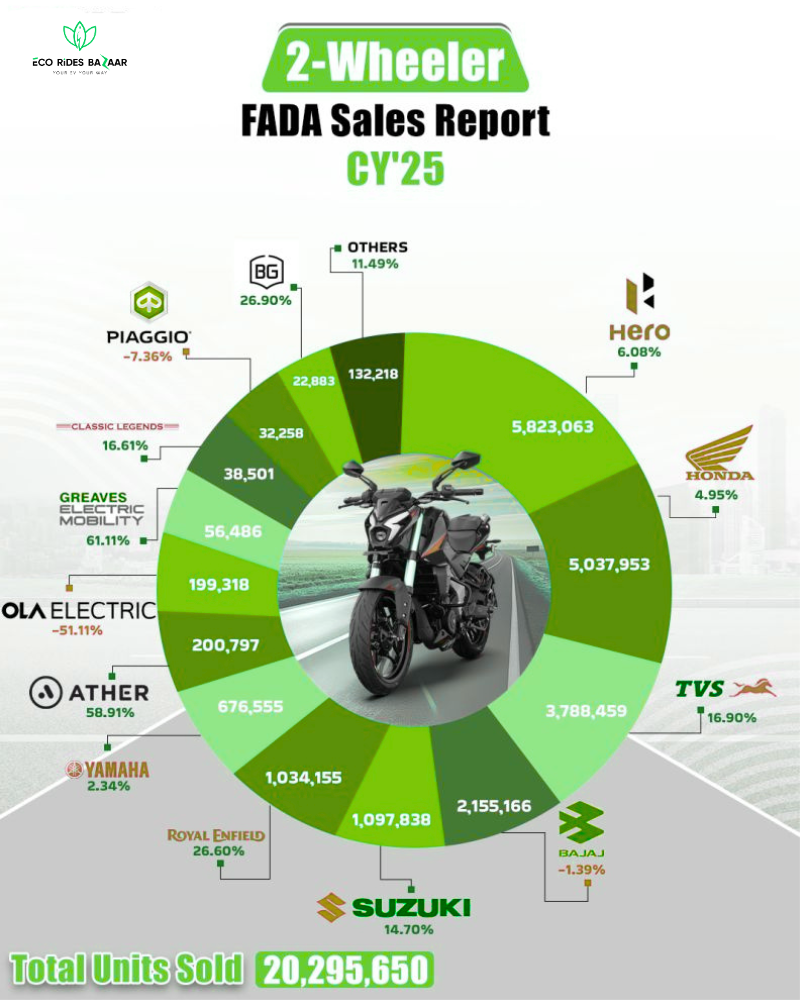
According to FADA, 20,295,650 two-wheelers were sold in 2025 — a 7.24% year-on-year growth. That kind of scale doesn’t come from trends alone. It comes from two-wheelers continuing to be the most practical and dependable form of mobility in India.
But the composition of that growth is where things get interesting.
📊 CY 2025 Two-Wheeler Sales
In CY 2025, the Indian two-wheeler market saw strong and varied performance across manufacturers, contributing to total sales of 2.03 crore units. Hero MotoCorp continued to lead the market with approximately 58.2 lakh units sold, registering a 6.08% year-on-year growth, reinforcing its dominance in mass mobility. Close behind, Honda sold around 50.4 lakh units, growing at 4.95% YoY, reflecting steady demand across both scooters and motorcycles.
TVS Motor Company emerged as one of the strongest performers of the year, recording sales of nearly 37.9 lakh units and an impressive 16.9% growth, indicating growing traction across its portfolio. In contrast, Bajaj reported sales of about 21.5 lakh units, marking a slight decline of 1.39%, suggesting pressure in specific segments. Suzuki showed healthy momentum with around 11.0 lakh units sold, supported by positive year-on-year growth.
In the mid-size and premium motorcycle space, Royal Enfield stood out with approximately 10.3 lakh units sold and a robust 26.6% growth, highlighting strong consumer demand for higher-displacement motorcycles. Yamaha, meanwhile, recorded sales of about 6.7 lakh units, posting a modest 2.34% growth during the year.
Electric two-wheelers continued to gain momentum within the broader market. Ather Energy reported a sharp 58.91% growth, while Greaves Electric Mobility led the EV growth charts with an even stronger 61.11% increase. BGauss also delivered healthy progress, growing by 26.9%, and the combined “Others” category in EVs and niche segments registered a 11.49% growth, underlining the expanding acceptance of electric mobility.
Together, these performances reflect a two-wheeler market that is not only growing in volume, but also diversifying rapidly across fuel types, segments, and consumer preferences.
🚲 What the Numbers Tell Us — Beyond the Headlines
1️⃣ The Backbone Remains Strong
The steady performance of large players like Hero, Honda, and TVS reinforces a simple truth: India still values reliability and reach. For millions, a two-wheeler isn’t a lifestyle choice — it’s a daily necessity.
Growth here isn’t driven by novelty. It’s driven by trust.
2️⃣ The Market Is No Longer One-Dimensional
Brands growing faster than the market average show that buyers are no longer making decisions on mileage alone. Performance, comfort, riding experience, and brand identity are playing a bigger role.
The market isn’t just growing — it’s diversifying.
3️⃣ EV Growth Is Real — and Context-Driven
The EV growth numbers stand out for a reason. When electric two-wheelers grow 50–60%+, it signals that EVs are moving past curiosity.
But it’s important to read this correctly.
EVs aren’t replacing everything overnight.
They’re fitting into specific, real-world contexts:
urban commuting
predictable daily distances
lower running costs
delivery and fleet use
This isn’t disruption for the sake of it. It’s adoption where things make sense.
4️⃣ The Biggest Change Is How People Decide
Perhaps the most important shift isn’t in sales numbers — it’s in decision-making.
Buying a two-wheeler today involves thinking about:
usage patterns
fuel vs charging convenience
upfront cost vs long-term savings
city conditions and traffic
reliability over time
As options increase, clarity becomes more important than ever.
🔮 The Road Ahead
Crossing 2 crore units shows the strength of India’s two-wheeler ecosystem.
But the next chapter won’t be defined only by how many vehicles are sold.
It will be defined by:
how clearly buyers understand their options
how confidently they choose between ICE and EV
and how well mobility solutions fit into real daily life
At Eco Rides Bazaar, we believe the future of mobility isn’t just electric —
it’s clear, contextual, and human.
Growth is here.
Now the focus shifts to making better decisions easier.